 516.466.4416
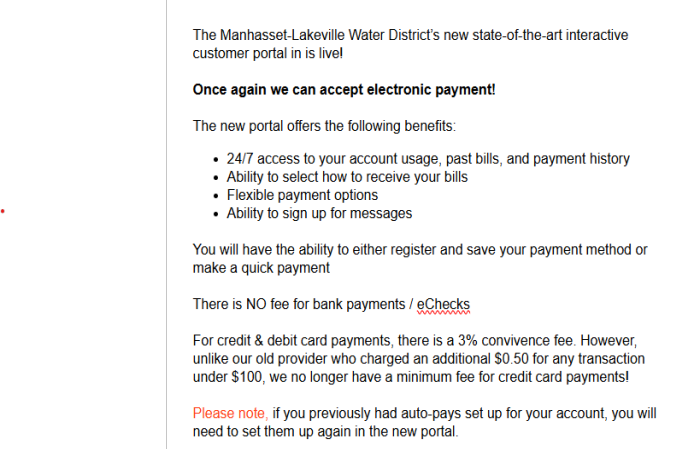
Register your account HERE... click register and follow the instructions. You will need to enter your account number, last name, zip code or
The email address/ phone number listed must match our records. If you run into an issue please call us at 516-466-4416 or email Jean@mlwaterd.org your account number, email address, and cell phone number.
About the MLWD
Manhasset-Lakeville Water District serves about 45,000 customers through over 10,000 individual service connections within a 10.2 square mile service area. The district produces its supply of potable water through the use of eighteen (18) separate wells located at thirteen (13) different sites throughout the Manhasset-Lakeville area.
The District's supply is drawn from underground aquifer systems that underlie our service area. Fourteen wells are set in the Magothy aquifer at depths between 100 and 470 feet while four wells are drilled into the deeper Lloyd aquifer at depths reaching 700 feet. Raw water treatment varies and includes disinfection, pH adjustment, aeration, and adsorption. The District maintains a minimum chlorine residual of 0.2ppm as required by the NYS Dept. of Health. All distribution water is in strict compliance with the New York State guidelines for potable water.
Currently, nine District wells are being treated for the removal of elevated levels of volatile organic compounds. Packed aeration towers (air strippers) or Granular Activated Carbon (GAC) filters are used to remove these organics. The raw water pH is raised to between 7.5 and 8.0 by the addition of a 25% sodium hydroxide solution (caustic soda). Since aeration also increases the pH of raw water, District wells, which are aerated, are not treated with sodium hydroxide. Three wells have been removed form service as part of the offsite remediation plan associated with the former Lockheed Martin site in Lake Success. One well has been removed from service for elevated nitrate levels.
The Water District currently maintains four (4) water storage tanks with a total volume of 5.5 million gallons. Two ground tanks hold a combined 4 million gallons while two elevated tanks hold a combined 1.5 million gallons. Five booster pumps are currently available to pump water from the ground tanks into the distribution system.
The District maintains two pressure zones. The high elevation of new communities along the eastern boundary of the District led to the creation of a high service area. Three centrifugal pumps are available to draw water from the distribution system and boost pressure to these communities. During periods of high demand, two variable speed well pumps can also be dedicated to this system. Outside of the high service area, system pressures are directly related to elevated tank levels and are maintained through the use of an integrated operations system consisting of phone lines, electronic monitoring devices, and computer software (SCADA). All stations are checked daily to ensure proper operation by our licensed New York State Water Treatment Plant Operators.
“If You See Something, Say Something”
We ask that any residents living nearby the Manhasset-Lakeville Water District’s water facilities help protect our water supply
system.
An important way you can help us is by immediately contacting us or the police if you see any trespassing, vandalism or other
dangerous or suspicious acts at one or more of our facilities or properties near your home.
By helping us prevent damage or disruptions to our water system we can ensure that you and the rest of our community are provided with uninterrupted, safe and adequate water service for household use and fire protection.
Therefore,
“If You See Something, Say Something” by calling 24/7 the:
Manhasset-Lakeville Water District at
516-466-4413
Nassau County Police Department at
516-573-6300 or 911
Read the latest Water Quality Report
H20
UPDATE 2025
L.I. Water Conference Assures High Water Quality
The Long Island Water Conference assures residents that
there has been no lead
contamination in their water supply for
over 30 years. All Long Island water providers exhaustively test
and treat for lead content. To ensure the water supply is not
contaminated with lead, all Long Island water
suppliers comply
with the United States Environmental Protection Agency’s (USEPA)
Lead and Copper Rule and treat the water by raising the pH to
help prevent the leaching of lead from household pipes and
plumbing fixtures.
Read
More...
SMART IRRIGATION CONTROLLER REBATE PROGRAM
Lawn Irrigation
In our District, lawn irrigation accounts for almost a billion gallons
of water usage each year. To promote conservation, the District has
entered into a partnership with the EPA’s WaterSense program. WaterSense,
a voluntary partnership program sponsored by the U.S. Environmental
Protection Agency (EPA), is both a label for water-efficient products
and a resource for helping you save water. The WaterSense label makes it
simple to find water-efficient products, and programs that meet EPA’s
criteria for efficiency and performance. WaterSense-labeled products and
services are certified to use at least 20 percent less water, save
energy, and perform as well as or better than regular models.
What is a Smart Sprinkler System?
A Smart Sprinkler System is an irrigation controller that can be
operated through a smartphone, tablet or laptop. The smart controller
manages the entire irrigation process of a home. Through Wi-Fi the
controller connects to local weather stations and various sensors
throughout the irrigation system monitoring precipitation, soil
temperatures and evapotranspiration rates. Each zone in the irrigation
system can be programmed to specify the grass type, number of
shrubs/plants, and shade or sun levels to prevent over-saturation and
runoff.
Standard clock sprinkler timers are often set at the beginning of the
season and forgotten about until the systems are shut off in the winter;
smart controllers are designed to remove all of the human error involved
in managing a home's irrigation system. WaterSense labeled irrigation
controllers, which act like a thermostat for your sprinkler system
telling it when to turn on and off, use local weather and landscape
conditions to tailor watering schedules to actual conditions on the
site, instead of irrigating using a controller with a clock and a preset
schedule.
Rebate Program
The Manhasset-Lakeville Water District through its partnership with the
EPA is offering a rebate on the cost of a qualified Smart irrigation controller device of up to $150, one per residence,
offer expires December 31, 2023. Smart irrigation controllers can significantly
reduce irrigation while still maintaining a healthy green lawn. In
addition to the rebate, owners can expect to see their usage fees drop,
so that over time, these devices will pay for themselves. If you’re
tired of high bills, please talk to your sprinkler company about
installing a new smart irrigation controller. Any controller labeled “WaterSense”
will qualify for the rebate.
To file for a rebate, simply submit an invoice along with the make and
model of the eligible controller to:
The Manhasset-Lakeville Water District
Rebate Program
170 East Shore Road
Great Neck, NY 11030
Or by Email to Info@mlwd.net
Information on the unregulated contaminant Dioxane can be found here